Meet the New Wildfire Action Plan: A Free Ready, Set, Go Plan for Your Household
A free, household-level wildfire plan built on Ready, Set, Go, with a two-minute readiness check that shows your gaps and what to do first.
Wildfire Action Plan is a free planning tool for households that live with wildfire risk. It works for homeowners and renters, takes about five minutes, and you don't need an account to begin. We rebuilt it around one practical question: if you had to leave tonight, would everyone in your home know what to do?
Here is what the plan covers, how the readiness check works, what to check in your insurance, and where to find official resources.
What Wildfire Action Plan Is
Wildfire Action Plan is organized around Ready, Set, Go, the same three-stage approach CAL FIRE uses in its Ready for Wildfire program. Our plan focuses on the household: the people, animals, papers and decisions that matter when you have to leave quickly.
The Three Planning Phases
The plan opens on a screen titled "Your Preparedness Stages" and asks you to select your current situation. Each stage shows the actions that fit that moment.
Ready
The plan labels this stage "Before a Fire" and describes it this way: "Take these essential steps now to ensure your family, home, and valuables are prepared for wildfire season." You get the ten-question readiness check, a Go Bag checklist, a place to list your invaluables and family heirlooms by category, an insurance coverage review, and an overview of the defensible space zones around a home.
Set
Labeled "Fire is Happening," this stage covers the window when "a fire is nearby but has not yet reached your home." You get a Pre-Evacuation Checklist sorted into Outside, Inside and Animals tasks, plus reminders to stage your heirlooms and move your Go Bag near an exit or into your vehicle.
Go
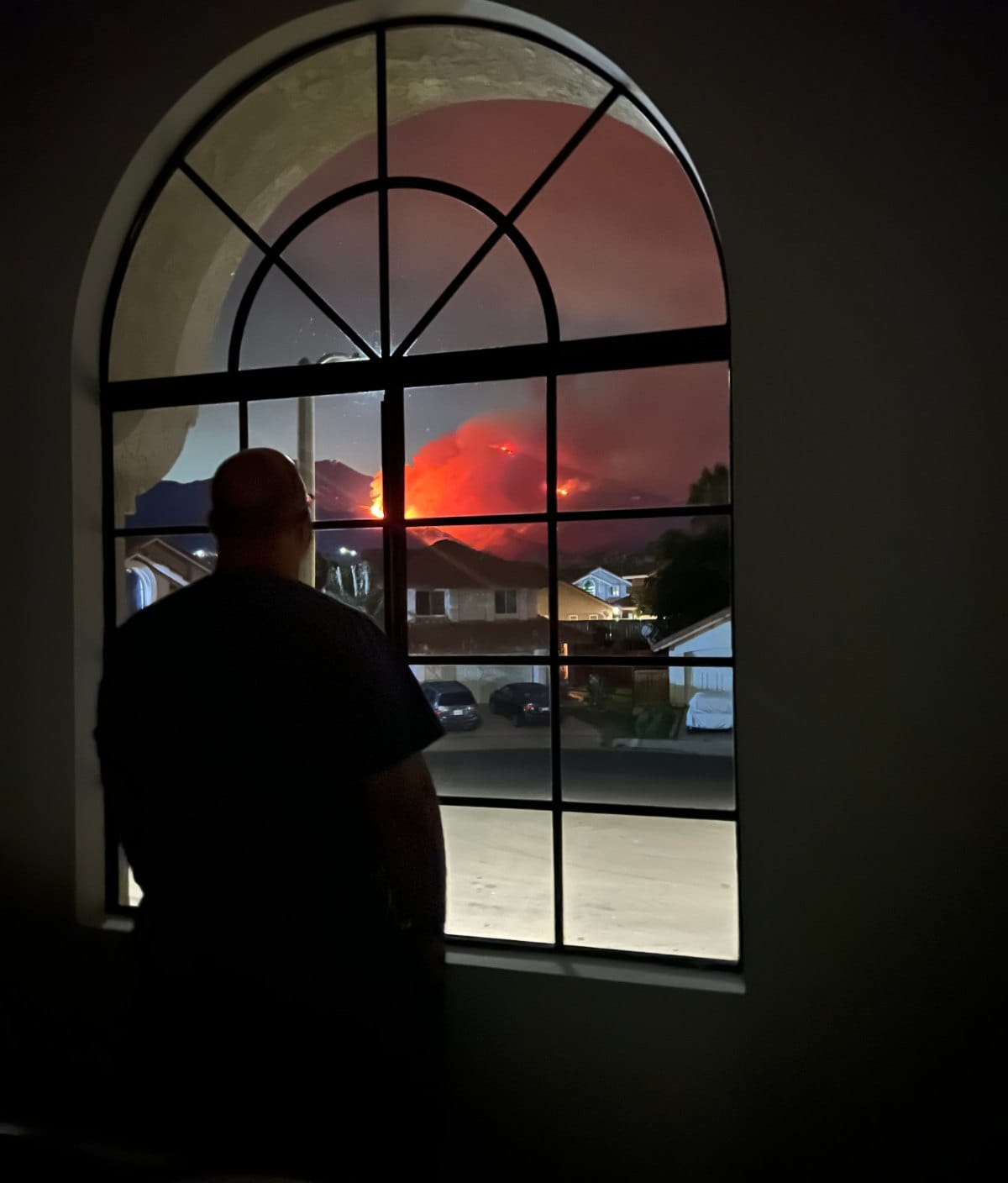
Labeled "Leave Immediately," this stage opens with a simple rule: "When you're told to evacuate, leave immediately. This keeps you safe and clears roads for firefighters." It lists the signs that it's time to go, such as an official evacuation order, visible fire, heavy smoke, interrupted power or water, or embers falling near your home. It also reminds you to leave before a mandatory order when you can, and not to return until officials say it's safe.
What Your Household Should Review
For each area the plan covers, here is what matters most.
Household, Pets and Animals
- Agree on a meeting place and an out-of-area contact everyone can call.
- Walk through the plan with everyone in the home, including anyone who would need help getting out.
- Ask yourself whether you could leave within fifteen minutes with every animal, and pack their food, water and leash in your Go Bag.
Alerts, Evacuation Routes and Your Vehicle
- Sign up for your county's emergency alerts. Cal OES keeps a county-by-county sign-up list.
- Know at least two ways out of your neighborhood that don't share the same road. If your county uses Genasys Protect, you can look up your evacuation zone there.
- During fire season, keep at least half a tank of gas and park facing out, as CAL FIRE's Go! Evacuation Guide advises.
Go Bag
- Pack it now and keep it somewhere you can grab on the way out.
- Plan on water for several days. Ready.gov recommends one gallon per person per day, and extra for pets.
- Include prescription medications, copies of important documents, cash, phone chargers and a change of clothes. The plan's checklist lists fifteen items in all.
Documents and Irreplaceable Items
- Store copies of important documents somewhere that would survive losing the house, such as a secure digital backup.
- Decide in advance which irreplaceable things you would take and where they are. The plan groups them as easy-to-carry art, photos, jewelry, valuables, digital data backups and other items.
Around the Home
- The Set checklist covers last-minute outside work, such as moving flammable items away from the house, turning off propane tanks and connecting garden hoses.
- Defensible space is the buffer you maintain around your home, reaching up to 100 feet or your property line. CAL FIRE explains the zones on its defensible space page.
- Wildfire Action Plan does not assess your landscape or your building. For those, our related tools are the Defensible Space Score, which looks at the ground around the home, and the Home Hardening Score, which looks at the structure itself.
What Your Readiness Band Means
The readiness check asks ten questions about your household and takes about two minutes. You answer Yes, Partly or No, with a Not Applicable option on the animals question. The questions are grouped as before a fire, when a fire is near, and leaving.
Your result is a readiness band, one of five: Under-prepared, Minimally Prepared, Partially Prepared, Substantially Prepared or Well Prepared. The plan shows no number or letter grade, because the answers measure how complete your preparations are, and a number would suggest more precision than they carry. You see your band and the first gaps worth closing right away. Unlock the full report by email and you get a specific next step for each gap, ordered by what takes the least effort first within what matters most.
The band is a snapshot of your preparations on the day you answer, so run it again as you work through the plan. It is a readiness measure only. It does not predict what will happen in a fire, it does not guarantee anyone's safety, and it has no bearing on any insurance decision.
Getting Your Insurance Coverage Right
Why Your Limits Matter After a Total Loss
When a home is destroyed, your dwelling coverage limit largely determines how much your policy will pay to rebuild. Some policies add extended or guaranteed replacement cost coverage above that limit. The number that matters is the cost to rebuild at today's labor and material prices, including current building codes. As United Policyholders explains, that figure can differ sharply from your home's market value or what you paid for it. Your belongings and the cost of living elsewhere while you rebuild carry their own separate limits.
How Often Homes Turn Out to Be Underinsured
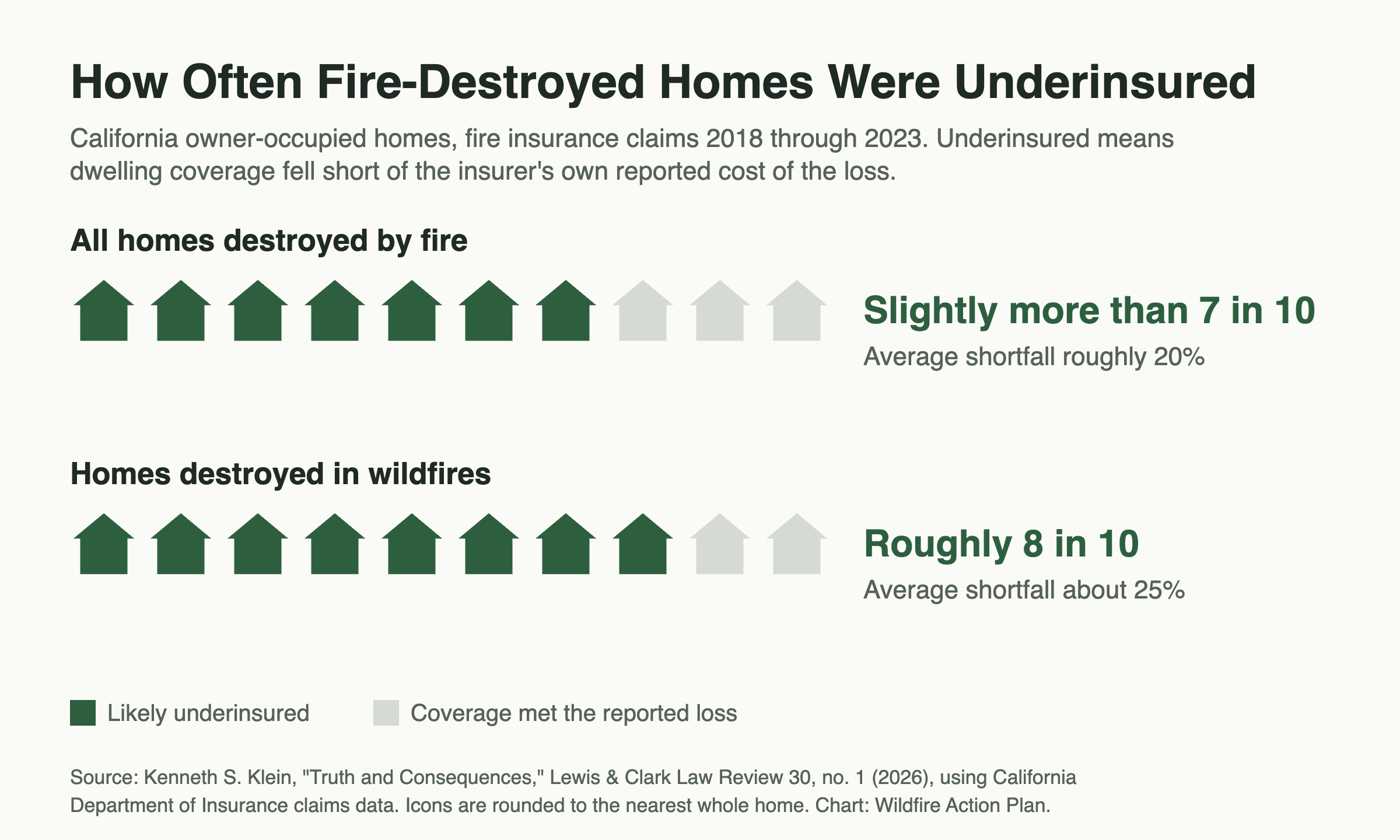
The most complete recent evidence comes from a 2026 study by law professor Kenneth S. Klein, published in the Lewis & Clark Law Review. Using California Department of Insurance data on fire claims for more than 74,000 owner-occupied homes from 2018 through 2023, he defined a home as underinsured when its dwelling coverage fell short of the insurer's own reported cost of the loss. By that measure, slightly more than seven in ten destroyed homes were likely underinsured, by roughly 20% on average. For homes destroyed in wildfires, the rate was roughly eight in ten, with an average shortfall of about 25%.
A separate, self-reported United Policyholders survey of Los Angeles wildfire survivors, taken about a year after the January 2025 fires, points the same way: 69% of total-loss respondents said their insurance would not cover the cost to rebuild.
California homeowners: check your coverage with Five Bays Insurance Agency, a licensed California agency, and see how mitigation may affect your insurability. This review is for homes in California only.
What We're Building Toward
Wildfire Action Plan is part of AACI Group, which also operates Five Bays Insurance Agency. Our longer-term goal is to gather the evidence needed to show insurance carriers that mitigation lowers wildfire risk, and to make the case that lower risk should mean better insurability and lower premiums. That is the goal we are working toward, and it is not yet proven.
What is already in place is California's Safer from Wildfires regulation, which requires insurers to recognize qualifying mitigation measures. Those measures apply to the property, such as the roof, vents and defensible space, rather than the household steps in this plan.
Resources for Building Your Emergency Action Plan
- CAL FIRE Ready for Wildfire: Ready, Set, Go guidance for home, family and evacuation.
- PG&E: wildfire safety and Public Safety Power Shutoff preparation, including alert sign-up.
- Ready.gov: wildfire preparation and how to build a kit.
- American Red Cross: wildfire safety before, during and after a fire.
- Cal OES: planning and preparedness, plus county alert sign-up and Genasys Protect evacuation zones.
Sources
- Klein, Kenneth S. "Truth and Consequences: What Catastrophe Teaches Us About Homeownership and Underinsurance." Lewis & Clark Law Review 30, no. 1 (June 10, 2026). https://lawcommons.lclark.edu/lclr/vol30/iss1/4/
- "United Policyholders LA Wildfires Year One Survey Report." United Policyholders, April 28, 2026. https://uphelp.org/united-policyholders-la-wildfires-year-one-survey-report/
- "Explaining to Homeowners Reconstruction Costs Versus Other Valuations." United Policyholders (from CoreLogic), March 23, 2019. https://uphelp.org/explaining-to-homeowners-reconstruction-costs-versus-other-valuations/
- "Safer from Wildfires." California Department of Insurance, accessed September 28, 2026. https://www.insurance.ca.gov/01-consumers/200-wrr/Safer-from-Wildfires.cfm
- "Prepare." CAL FIRE Ready for Wildfire, accessed September 28, 2026. https://www.readyforwildfire.org/prepare-for-wildfire/
- "Go! Evacuation Guide." CAL FIRE Ready for Wildfire, accessed September 28, 2026. https://www.readyforwildfire.org/prepare-for-wildfire/go-evacuation-guide/
- "Defensible Space." CAL FIRE Ready for Wildfire, accessed September 28, 2026. https://www.readyforwildfire.org/prepare-for-wildfire/defensible-space/
- "Build a Kit." Ready.gov, FEMA, accessed September 28, 2026. https://www.ready.gov/kit
- "Wildfires." Ready.gov, FEMA, accessed September 28, 2026. https://www.ready.gov/wildfires
- "Wildfire Safety." American Red Cross, accessed September 28, 2026. https://www.redcross.org/get-help/how-to-prepare-for-emergencies/types-of-emergencies/wildfire.html
- "Community Wildfire Safety Program." PG&E, accessed September 28, 2026. https://www.pge.com/en/outages-and-safety/safety/community-wildfire-safety-program.html
- "Public Safety Power Shutoffs." PG&E, accessed September 28, 2026. https://www.pge.com/en/outages-and-safety/safety/community-wildfire-safety-program/public-safety-power-shutoffs.html
- "Planning and Preparedness." California Governor's Office of Emergency Services, accessed September 28, 2026. https://www.caloes.ca.gov/office-of-the-director/operations/planning-preparedness-prevention/planning-preparedness/
- "County Alert Sign-Up." Cal OES CalAlerts, accessed September 28, 2026. https://calalerts.org/signup.html
- "Genasys Protect." Genasys, accessed September 28, 2026. https://protect.genasys.com/