Your Wildfire Preparedness Plan for Northern California
A wildfire preparedness plan Northern California can help protect your family, home, and insurance. Get practical steps and local resources to stay ready.
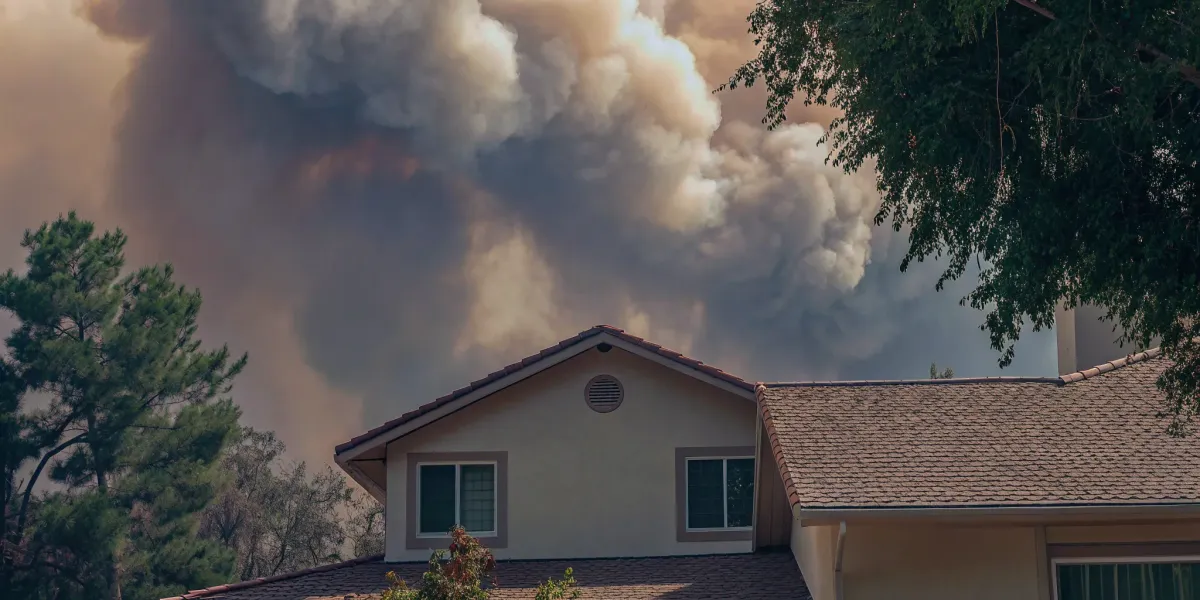
Living in Northern California means dealing with a new reality: the home insurance crisis. If you’ve received a non-renewal notice or seen your premiums skyrocket, you know the frustration and uncertainty it causes. It can feel like you’re being punished for something outside your control. But you have more power than you think. Taking clear, documented steps to protect your property is the single best way to lower your risk profile and fight for your insurability. This isn't just about safety anymore; it's about financial stability. A comprehensive wildfire preparedness plan Northern California insurers can see demonstrates you are a proactive partner in reducing risk. This guide will walk you through the essential actions that protect your family and show insurers you’re serious about defending your home.
Pay Less for Home Insurance
and Avoid Non-Renewal?
Our partner, Five Bays Insurance Agency, offers a free policy checkup that spots hidden discounts to make sure you’re not paying more than you should.
Key Takeaways
- Prioritize Home Hardening to Stay Insurable: Your property's physical defense is non-negotiable for both safety and insurance. Focus on the most impactful actions first: create a 5-foot ember-free zone around your foundation and ensure you have a Class A fire-rated roof to significantly lower your risk.
- A Practiced Evacuation Plan Prevents Panic: Your family's safety depends on a plan that works under pressure. Assemble "Go Bags" for everyone, map multiple escape routes, and establish a single out-of-state contact. Rehearsing these steps turns your strategy into a life-saving reflex when every second counts.
- A Plan Is Only Effective When It's Shared: Don't let your plan sit in a binder. Ensure every family member knows the communication strategy and meeting spots. Connect with your neighbors to build a local safety network, creating a coordinated response that protects the entire community.
Why You Need a Wildfire Plan in Northern California
Living in Northern California means accepting that wildfire is a part of life. But accepting the risk doesn’t mean accepting the consequences. A clear, actionable wildfire plan is your most powerful tool for protecting your family, your home, and your financial stability. It turns anxiety into action and gives you control in an unpredictable situation. Let’s break down why having a plan is no longer optional.
How Serious is the Wildfire Risk?
The threat of wildfire in Northern California is not a distant problem; it's a present and growing reality. A changing climate is making the state’s existing wildfire management challenges more severe, with dry seasons that are longer and more intense than ever before. This isn't just happening in remote forests. According to the state’s Wildfire Task Force, a high potential for wildfire hazard exists in every single county in Northern California. This is the new normal, and waiting for a fire to threaten your neighborhood is no longer a viable strategy. A proactive plan is the only way to prepare for a threat that is now a year-round concern.
The High Cost of Being Unprepared
The true cost of being unprepared for a wildfire isn't just measured in property—it's measured in chaos and regret. When an evacuation order comes, you have minutes, not hours, to act. Without a plan, panic sets in. What do you take? Where do you go? How will you contact your loved ones if cell service is down? As CAL FIRE emphasizes, the fire season is now a year-round reality, meaning you must have a wildfire action plan ready at all times. When a disaster strikes, your family might not be together. A solid communication strategy and a pre-packed "go bag" can make all the difference between a calm, orderly evacuation and a frantic, terrifying scramble.
Facing Insurance Hurdles: Non-Renewals and Rising Costs
The wildfire crisis has created a parallel crisis in the home insurance market. As fires become more frequent and destructive, insurers are pulling back from high-risk areas, leaving homeowners with non-renewal notices, skyrocketing premiums, or forcing them onto the expensive California FAIR Plan. Your ability to protect your home is now directly tied to your ability to insure it. The good news is that you can take steps to lower your risk profile. Programs like the California Wildfire Mitigation Program focus on making homes more fire-resistant. Creating a documented plan that includes home hardening and defensible space isn't just for safety—it's a critical step toward staying insurable.
What Goes Into a Wildfire Preparedness Plan?
When you live in Northern California, a wildfire plan is not a “nice-to-have”—it’s an essential tool for your family’s safety. Thinking through the chaos before it happens gives you a clear, actionable roadmap to follow when stress is high and every second counts. A strong plan is more than just a packed bag by the door. It’s a comprehensive strategy that covers how you’ll communicate with loved ones, where you’ll go, what you’ll bring, and how you’ve prepared your home to be as resilient as possible. Breaking down this big task into smaller, manageable steps makes preparation feel attainable, not overwhelming.
Set Up Your Emergency Contacts and Communication Plan
When a wildfire forces an evacuation, cell towers can become overloaded or damaged, and power outages can knock out internet service. Don’t rely on your smartphone as your only connection. Your first step is to create a family communication plan that works even when technology fails. Designate a single out-of-state friend or relative as the central point of contact for everyone in your household. It’s often easier to make a long-distance call than a local one during a regional disaster. Make sure every family member has this person’s number saved. Also, create a physical list of important contacts—including doctors, schools, and your insurance agent—and keep a copy in your car and your emergency kit.
Map Your Evacuation Routes and Meeting Spots
During an emergency, your usual route home could be blocked by fire or traffic. You need to know multiple ways out. Identify at least two different evacuation routes from your neighborhood and practice driving them. Familiarity with the roads can reduce panic when you need to leave quickly. Next, establish two meeting spots. The first should be a safe location nearby, like a specific landmark in a park or a neighbor’s house outside the immediate danger zone. The second should be farther away, such as a relative’s home or a motel in a neighboring town, in case you can’t return to your area for a while. Ensure everyone in your family knows these locations and has them written down.
Gather Your Key Documents and Insurance Details
If you have to evacuate, you may not have time to search for critical paperwork. Gather your essential documents now and keep them in one accessible place. This includes copies of birth certificates, passports, social security cards, driver’s licenses, and property deeds. Don’t forget your insurance policies and a recent home inventory—a simple video you take on your phone walking through your house, narrating your belongings, is perfect for this. Store digital copies of these files on a secure cloud service and keep physical copies in a portable, fire-resistant lockbox or a designated “grab-and-go” folder. Having this information organized will be invaluable for recovery and filing insurance claims.
Your Essential Home Hardening Checklist
Your preparedness plan shouldn’t just focus on leaving; it should also include steps to help your home survive a wildfire. This is called “home hardening.” The goal is to make your property less vulnerable to embers, which are the leading cause of homes igniting during a wildfire. Start with the most critical areas: your roof, vents, and windows. A Class A fire-rated roof is your best defense. Cover all attic and crawl space vents with 1/8-inch metal mesh to block embers from getting inside. Finally, creating a five-foot, ember-resistant zone directly around your home is one of the most effective actions you can take. These proactive steps are a core part of any wildfire mitigation guide and can significantly improve your home’s chances.
How to Create Defensible Space Around Your Home
Creating defensible space is one of the most effective actions you can take to protect your home from a wildfire. It’s the buffer you create between your house and the grass, trees, shrubs, or any wildland area surrounding it. This space is essential to slow or stop the spread of wildfire and protect your home from catching fire—either from direct flame contact or radiant heat. For insurers, a well-maintained defensible space is a clear sign that you are actively managing your property’s risk, which can be a critical factor in maintaining your coverage.
The concept is based on a series of zones that extend out from your home. Each zone has a different set of requirements for clearing and managing vegetation. Think of it as creating layers of protection, with the most stringent clearing happening closest to your house. According to CAL FIRE, this buffer is required by law in many parts of California and is divided into three main zones. Taking the time to establish and maintain these zones doesn’t just give firefighters a safer area to defend your home—it significantly increases your home’s chance of survival.
Clear Zone 0: The Ember-Resistant Zone (0-5 feet)
This is the area immediately surrounding your home, and it’s the most vulnerable. The goal here is to create a space where embers cannot ignite anything that could carry fire to your house. CAL FIRE calls this the Ember-Resistant Zone, and it should be completely free of combustible materials. This means removing wood mulch, flammable plants, wood piles, and even outdoor furniture with flammable cushions. Instead, use non-combustible materials like gravel, pavers, or concrete. Trim any tree branches that hang over your roof or are within 10 feet of your chimney. This zone is your last line of defense against the flying embers that are responsible for igniting most homes during a wildfire.
Maintain Zone 1: Lean, Clean, and Green (5-30 feet)
The next layer of defense extends from 5 to 30 feet from your home. In this zone, the goal is to interrupt a fire’s path by eliminating continuous vegetation that could act as fuel. This is what CAL FIRE refers to as the "Lean, Clean, and Green" zone. You should remove all dead plants, dry grass, and fallen leaves. Trees and shrubs should be well-spaced to prevent fire from jumping between them. Prune trees to keep the lowest branches at least six feet off the ground. By keeping this area properly maintained, you can help stop a fire before it reaches your house, giving firefighters a crucial advantage.
Manage Zone 2: The Reduced Fuel Zone (30-100 feet)
This zone extends from 30 feet out to 100 feet (or your property line). The objective here is not to clear the land completely but to reduce the amount of available fuel. This means thinning out dense vegetation to slow a fire’s spread and lessen its intensity. Remove smaller trees and shrubs growing between larger, healthier trees. Mow annual grasses down to a maximum height of four inches. Properly managing this zone creates a vital buffer that can significantly decrease the heat and intensity of an approaching wildfire. It’s about creating a more fire-resistant environment that is easier for firefighters to defend.
Choose Fire-Resistant Plants for Your Landscape
Your landscaping choices can play a huge role in your home’s defense. When planning your garden, it’s smart to select fire-resistant plants that are less likely to ignite and can help create a natural barrier against flames. These plants typically have a high moisture content and a low amount of flammable sap or resin. Good choices for Northern California include succulents, lavender, and native perennials like yarrow. Avoid highly flammable plants such as juniper, cypress, and eucalyptus, especially in Zone 0 and Zone 1. Integrating fire-wise landscaping adds another powerful layer of protection to your home while still allowing you to have a beautiful yard.
Which Home Hardening Steps Actually Lower Your Risk (and Insurance Premiums)?
When you live with wildfire risk, protecting your home can feel like a constant challenge. But "home hardening"—making physical changes to your house to help it withstand a wildfire—is one of the most powerful ways you can take back control. These upgrades are designed to protect your home from the two biggest threats: direct flames and flying embers, which can travel a mile or more ahead of a fire.
Making these changes is an investment, but it’s one that pays off in both peace of mind and financial stability. Insurers are paying close attention to the steps homeowners take to reduce their risk. In California, they are now required to offer discounts for specific mitigation efforts. While some of these discounts are small right now, they are a critical first step toward rewarding proactive homeowners. More importantly, these actions are becoming essential for simply keeping your insurance policy. A hardened home is a more insurable home. Your Wildfire Action Plan can help you track these upgrades and create a clear record of your efforts for your insurer.
Install Fire-Resistant Roofing and Siding
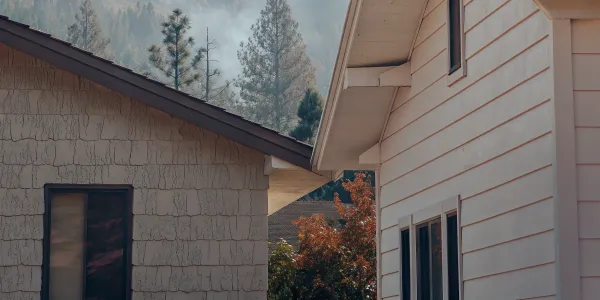
Your roof is your home's first line of defense against a shower of embers. It's the most vulnerable surface, so choosing the right material is non-negotiable. The goal is to have a Class A fire-rated roof, which is the most effective at preventing fire from taking hold. Materials like composite shingles, metal, concrete, and clay tiles offer this level of protection. If you have an older wood-shake roof, replacing it should be your top priority.
Similarly, your home's siding acts as a shield. Traditional wood siding can easily ignite, but as CAL FIRE explains, fire-resistant options like stucco, fiber cement, and brick are crucial for blocking flying embers and protecting your home from intense heat.
Secure Your Windows, Vents, and Eaves
Embers are tiny, relentless, and can find their way into your home through the smallest openings. Securing these entry points is a critical part of home hardening. Start with your windows. Single-pane windows can shatter from the heat of a nearby fire, giving embers a direct path inside. Upgrading to dual-pane windows with tempered glass on the exterior pane makes them much more resilient.
Vents—for your attic, foundation, or dryer—are also vulnerable. Cover all vent openings with 1/8-inch metal mesh to block embers while still allowing for airflow. Finally, look at your eaves. Open eaves can trap hot air and embers, creating a perfect spot for a fire to start. Enclosing or "boxing in" your eaves with fire-resistant materials eliminates this dangerous trap.
Make Smart Upgrades to Decks and Fences
A wooden deck or fence attached to your house can act like a fuse, leading a fire directly to your structure. To prevent this, you need to create a break. If you have a wooden deck, ensure the first five feet of the wall nearest to it has non-combustible siding. Keep the area underneath the deck clear of leaves, debris, and anything flammable. When it's time to rebuild, choose ignition-resistant materials.
For fences, the same principle applies. If a combustible fence connects to your house, it creates a direct path for fire. The simplest solution is to replace the five feet of fencing closest to your home with a metal gate or a section made of non-combustible materials. This small change can make a huge difference.
How to Qualify for Home Insurance Discounts
With insurers in California now required to offer discounts for wildfire mitigation, your home hardening efforts can directly impact your premium. To qualify, you need to show your insurance provider that you’ve taken concrete steps to prepare your home. This means documenting everything—from your new Class A roof to the metal mesh on your vents and your well-maintained defensible space.
Some insurers may require a formal inspection or certification to verify your work. Keep receipts and take before-and-after photos of your projects. While the discounts may not cover the full cost of an upgrade in the first year, they add up over time. More importantly, these actions demonstrate that you are a lower-risk policyholder, which is becoming the most important factor in maintaining affordable coverage.
How to Build Your Emergency Kit and Evacuation Plan
Even with a well-prepared home, your personal safety comes first. When a wildfire threatens your community, you may have only minutes to leave. A clear, practiced evacuation plan is not just a good idea—it’s a critical tool for survival. It removes the guesswork and panic from a high-stress situation, ensuring you and your family can get out safely and efficiently. This involves preparing what to take, knowing where to go, and deciding when to leave. Taking these steps gives you control when it matters most, protecting your family from harm and setting you up for a smoother recovery.
Pack Your "Go Bag" with Essential Supplies
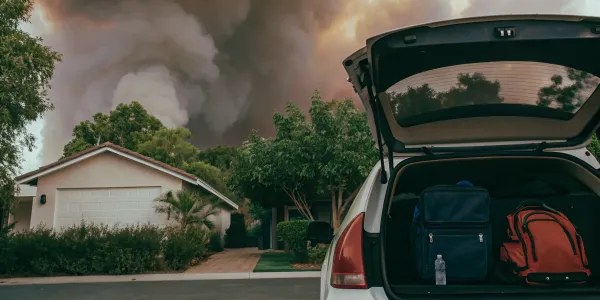
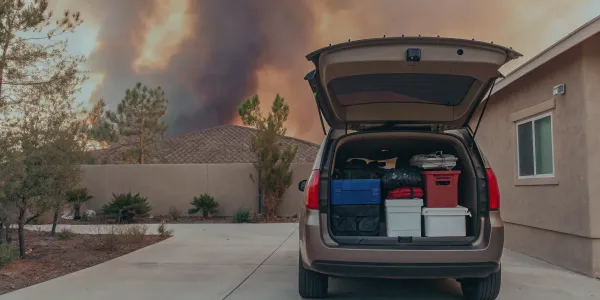
When an evacuation order is issued, you won’t have time to search for necessities. Every person in your household, including children, needs a dedicated "Go Bag" that’s light and ready to grab. This isn't a suitcase for a long trip; it's a survival kit for the first 72 hours.
Your bag should include:
- Water and non-perishable food for three days
- A first-aid kit and a supply of any prescription medications
- A flashlight, hand-crank radio, and extra batteries
- Copies of important documents and cash in small bills
- Personal hygiene items and a change of clothes
Check your kits every six months to rotate out expired food, water, and medications. You can use a comprehensive emergency supply checklist to make sure you haven’t missed anything important.
Prep Your Grab-and-Go Document Folder
In the chaos of an evacuation, essential paperwork is easy to forget but difficult to replace. Prepare a portable, waterproof folder or container with all your critical documents. This folder should be stored with your Go Bags so you can grab it in a hurry. Include copies of birth certificates, passports, social security cards, and driver’s licenses. Also, add copies of insurance policies, property deeds or rental agreements, and bank account records. It’s also smart to take photos and videos of your home’s interior and exterior for insurance purposes. Store digital copies of everything on a password-protected flash drive in your kit and on a secure cloud service for backup.
Plan Multiple Escape Routes and Know When to Leave
Your primary route out of the neighborhood might be blocked by fire or traffic, so you need backups. Identify at least two different escape routes from your home and map them out. Drive these routes so you are familiar with them, and share the plan with your entire family. Designate several meeting spots in case you get separated: one just outside your neighborhood, another outside your town, and a third out-of-state contact person everyone can check in with. The most important rule is to leave as soon as an evacuation order is issued. Don’t wait. A personalized Wildfire Action Plan can help you map your routes and organize your strategy so you’re ready to act without hesitation.
Don't Forget a Plan for Pets and Livestock
Your animals depend on you for their safety. For household pets, prepare a Go Bag with food, water, medications, leashes, and copies of their medical records. Make sure they are microchipped and wearing ID tags. Keep pet carriers accessible and get your animals comfortable with them ahead of time. Research pet-friendly hotels or shelters outside your immediate area, as many emergency shelters cannot accommodate animals. For livestock, the planning is more complex. Work with neighbors or local agricultural groups to establish transportation and shelter plans well before a fire strikes. Have a plan to leave early, as moving large animals takes significant time and coordination.
How to Share Your Wildfire Plan with Family and Neighbors
A wildfire plan is a powerful tool, but it’s useless if it only lives in your head or a forgotten binder. During an emergency, stress is high and time is short. Sharing your plan with family and neighbors turns individual preparedness into a coordinated, community-wide response. It ensures everyone knows their role, how to communicate, and where to go. When every person is on the same page, you create a stronger, more resilient safety net for the entire neighborhood. A clear, shared strategy is the key to moving quickly and safely when it matters most.
Think of it this way: first responders are often stretched thin during a major wildfire. Your immediate support system is your family and the people living next door. By coordinating your plans, you can check on each other, share real-time information about road closures or fire behavior, and help those who might need extra assistance, like elderly neighbors or families with small children. This collective effort doesn't just improve your own chances of a safe evacuation; it strengthens the entire community's ability to withstand the crisis. The time to have these conversations is now, not when you see smoke on the horizon. You can build and share your strategy with our free Wildfire Action Plan.
Create Your Family Communication Strategy
In the chaos of an evacuation, it’s easy to get separated. Local phone lines can become overloaded or go down entirely, making it difficult to check in. That’s why your family communication plan should designate a single point of contact who lives outside your immediate area. As CAL FIRE suggests, this strategy "names someone outside the area to be the main contact point for all family members if you get separated." Make sure everyone, including children, has this person’s name and number saved in their phone and written down in their go-bag. This person becomes the central hub for information, allowing family members to report that they are safe and get updates on others without jamming local networks.
Connect with Neighbors to Build a Safety Network
You are not in this alone. Your neighbors are your most immediate allies during a wildfire. A strong neighborhood network can make a critical difference, especially for checking on elderly residents or those who may need extra help evacuating. Start by exchanging phone numbers and creating a neighborhood contact sheet or group chat. Discuss your plans. Who has pets that might need help? Does anyone have medical needs that require special attention? Knowing this information ahead of time allows you to look out for one another when an alert is issued. A connected community is a safer community, and it starts with a simple conversation over the fence.
Practice Your Evacuation Plan Together
A plan on paper is just a theory. Practice is what turns it into a life-saving reflex. You need to create and practice an emergency preparedness plan with everyone in your household. Schedule a family drill at least twice a year. Time how long it takes to get your go-bags, load your pets, and get everyone into the car. Physically drive your planned evacuation routes—all of them. See what they look like at different times of day and identify potential bottlenecks. After each drill, talk about what worked and what didn’t. Did you forget anything? Was a specific step confusing? Refining your plan through practice ensures that when the time comes, everyone can act with confidence instead of panic.
Use Tech to Stay Connected During an Emergency
Your phone can be your most powerful tool in a crisis, but you have to use it wisely. During an emergency, cell networks can become congested with calls. To keep lines open for emergency services, "use text messages, email and social media instead of making phone calls" for non-urgent check-ins. Texts are more likely to get through when service is spotty. Set up a family group chat ahead of time for quick updates. Use social media features like Facebook’s Safety Check to let a wide network of friends and family know you’re okay with a single click. Most importantly, make sure everyone has a portable power bank in their go-bag to keep their devices charged.
What Local Resources Can Help You Prepare?
Creating a wildfire plan can feel overwhelming, but you don’t have to figure it all out on your own. California offers a surprising number of programs and resources designed to help homeowners prepare. Tapping into these resources can make your home safer, your plan stronger, and the entire process much more manageable. Instead of trying to reinvent the wheel, you can lean on the expertise of state agencies, find financial support for critical home upgrades, and connect with neighbors who are working toward the same goals.
These programs are specifically designed for residents in high-risk areas and provide a clear roadmap for taking action. They can help you translate abstract safety concepts into concrete tasks, like how to properly create defensible space or which home hardening retrofits offer the most protection. Many of these resources are free and easily accessible online, putting expert advice right at your fingertips. By leveraging these tools, you move from a place of anxiety to one of empowerment, knowing you're taking proven steps to protect your family and property. From state-level guidance and funding to hyper-local community groups, there are people and tools ready to support you. Let's look at some of the best places to start.
Tap into CAL FIRE Resources and Programs
CAL FIRE’s "Ready, Set, Go!" program is one of the most valuable resources for any California homeowner. It’s a straightforward, three-step guide that walks you through exactly how to prepare your property and your family for wildfire. The "Ready" phase focuses on creating defensible space and hardening your home against embers. "Set" is about creating a solid action plan, and "Go!" covers what to do when it’s time to evacuate. This isn't just a vague suggestion; it's a detailed framework that gives you clear, actionable steps. Following this program helps you proactively reduce your risk long before a fire is on the horizon.
Find Funding Through the Wildfire Mitigation Program
Let’s be honest: home hardening projects can be expensive. Replacing a roof or installing ember-resistant vents costs money, and that can be a major barrier for many families. That’s where the California Wildfire Mitigation Program (CWMP) comes in. This state-run program provides financial assistance to help homeowners and communities complete projects that make properties more fire-resistant. It’s designed to make wildfire safety more accessible for everyone. If the cost of upgrades is holding you back, it’s absolutely worth looking into the CWMP to see if your projects qualify for funding.
Get Involved with Local Fire Safe Councils
Wildfire preparedness isn’t just about your individual property—it’s a community effort. Joining or starting a local Fire Safe Council is one of the most effective ways to work with your neighbors on shared safety goals. These resident-led groups collaborate on everything from organizing community clean-up days to applying for grants for larger fuel reduction projects. Being part of a council gives you access to tailored advice for your specific neighborhood and connects you with a support system of people who share your concerns. You can find an existing group or learn how to start your own council in your area.
Use Apps and Tools for Real-Time Alerts
When a wildfire is approaching, timely and accurate information is critical. Your phone can be one of your most powerful preparedness tools. CAL FIRE offers a Ready for Wildfire app that allows you to create a personalized evacuation checklist and receive alerts about nearby fires. Beyond that, make sure you’re signed up for your county’s emergency alert system (often called Nixle or a similar service). These systems will send text messages directly to your phone with evacuation warnings and orders. Having these digital tools set up ahead of time ensures you get the information you need to act quickly and keep your family safe.
Common Wildfire Preparedness Mistakes to Avoid
Creating a plan is a huge step forward, but some common missteps can undermine your hard work. Knowing what these pitfalls are ahead of time helps you build a truly effective strategy that keeps your family safe and your property protected. Let's walk through the most frequent mistakes people make so you can avoid them and feel confident in your preparations. Taking these extra steps ensures your plan will hold up when it matters most.
Mistake #1: Waiting Too Long to Leave
This is one of the most dangerous mistakes you can make. When evacuation orders are issued, it’s because the danger is real and imminent. It’s easy to think you have more time than you do, but wildfires can move unpredictably and faster than you can imagine. Roads can become gridlocked or blocked by fire, cutting off your escape. As CAL FIRE advises, you should always "be ready to evacuate early: Don't wait until the last minute to leave if you are told to evacuate." Trust the experts and leave as soon as the order is given. Your life is more important than your property, and hesitating can put you and first responders in a terrible position.
Mistake #2: Having No Communication Plan
In the stress and confusion of an evacuation, it’s easy for family members to get separated. Cell service can be unreliable, and power outages are common. Without a plan, panic can set in. A solid family communication strategy is your lifeline. This means designating a single friend or relative who lives out of the area as the central point of contact for everyone to check in with. Make sure everyone in your household has this person’s number saved in their phone and written down in their go bag. You should also have pre-determined meeting spots—one near your home and another outside your immediate neighborhood—in case you can’t get home or need to reunite.
Mistake #3: Forgetting About Insurance Details
After a fire, the last thing you want is a financial crisis. Yet, many homeowners don't review their insurance policies until it's too late. It’s a critical step to "review your insurance policy to ensure you have adequate coverage for wildfire damage." Do you know your deductible? Are you covered for the full cost of rebuilding, including debris removal and temporary living expenses? Take an afternoon to call your agent, ask these specific questions, and document the answers. Make sure you have a digital and physical copy of your policy in your go bag. This single step can provide immense peace of mind and financial stability when you need it most.
Mistake #4: Making a Plan and Never Looking at It Again
A wildfire plan isn't a document you create once and file away. It’s a living strategy that needs to be reviewed and practiced. Your family’s needs change, evacuation routes can be affected by new construction, and contact information gets updated. As Ready.gov recommends, you need to "prepare your plan and practice it regularly with your family to ensure everyone knows what to do." Running through a drill helps build muscle memory, so actions become automatic in a high-stress situation. It also helps you spot weaknesses in your plan. Set a reminder on your calendar to review and practice your plan at least twice a year—it’s a small time investment for a massive return in safety.
Related Articles
- 7 Fire Resistant Home Improvements for Northern California
- Home Fire Defense Plan Northern California: A Guide
- 5 Steps to a Custom Wildfire Action Plan: NorCal
Pay Less for Home Insurance
and Avoid Non-Renewal?
Our partner, Five Bays Insurance Agency, offers a free policy checkup that spots hidden discounts to make sure you’re not paying more than you should.
Frequently Asked Questions
I'm feeling overwhelmed by all this. What's the first step I should take? Start with the area you can control today. Walk the perimeter of your house and focus on the first five feet. This is your ember-resistant zone. Clear out any dead leaves, wood mulch, or flammable plants right up against your foundation. This single action costs nothing but your time and is one of the most effective ways to prevent embers from igniting your home. Once that’s done, move inside and pack a simple "Go Bag" with essentials for each family member. Taking these two small, concrete steps can build momentum and make the rest of the process feel much more manageable.
What's the difference between "home hardening" and "defensible space"? Think of it this way: defensible space is about managing the land around your house, while home hardening is about improving the physical structure of the house itself. Creating defensible space involves clearing vegetation in zones to slow a fire’s approach. Home hardening involves projects like installing a fire-resistant roof, covering vents with metal mesh, and upgrading to dual-pane windows to stop embers from getting inside. Both are critical, as they work together to give your home the best possible chance of survival.
Will these actions actually help me keep my home insurance? Yes, they are becoming essential. As insurers pull back from high-risk areas, they are looking for clear evidence that homeowners are actively reducing their wildfire risk. Creating defensible space and hardening your home shows them you are a more responsible, lower-risk client. While discounts are still evolving, these actions are increasingly the baseline requirement for getting or keeping a policy. Be sure to document all your work with photos and receipts to create a clear record for your insurance provider.
My budget is tight. What are the most cost-effective actions I can take right now? Many of the most effective preparedness steps are about maintenance, not expensive retrofits. Start by thoroughly cleaning your roof and gutters of all leaves and pine needles. Clear all flammable materials within five feet of your home’s foundation. Mow dry grass and prune low-hanging tree branches. Covering your vents with 1/8-inch metal mesh is another low-cost, high-impact project you can do yourself. These actions directly address the threat from embers and can be done with a small budget.
How often should I review and practice my evacuation plan? A plan is only useful if it’s current and familiar. You should review your plan with your family at least twice a year, perhaps when you change the clocks or check your smoke detector batteries. Check your emergency kits for expired food or medications at the same time. It’s also important to physically drive your primary and secondary evacuation routes a couple of times a year. This practice builds muscle memory, so if you ever need to leave under stress, the process feels automatic rather than panicked.